


Economics is an interesting subject, here value of goods and services are not solely determined by how useful they are, it is largely influenced by the concept of scarcity, i.e., how limited a resource is compared to its demand. This concept is widely used in economics and is fundamental to various popular theories. There is a direct relationship between scarcity and the price of a product; it influences the decisions of consumers, businesses, and even governments.
This article will explore this concept in detail, understand how scarcity creates value, why prices rise or fall, and more, so keep reading.
Also Read : How Many Calories Are in a Fried Chicken Breast? A Complete Guide
What Is Economic Value?
Economic value is the amount people are ready to pay for a product or service. It depends on various factors, such as its availability, utility, substitutes available in the market, and more.
For example:
A bottle of water costs 20 in a city marketThe same bottle can cost 100 in a desert
The product is the same, and factors like quality and quantity are similar, but the price is significantly higher in the desert area, why so? It is because in a desert area, availability of water is limited, it is hard to find drinkable water, which makes a water bottle a scarce resource in a desert area.
The Role of Scarcity in Economics
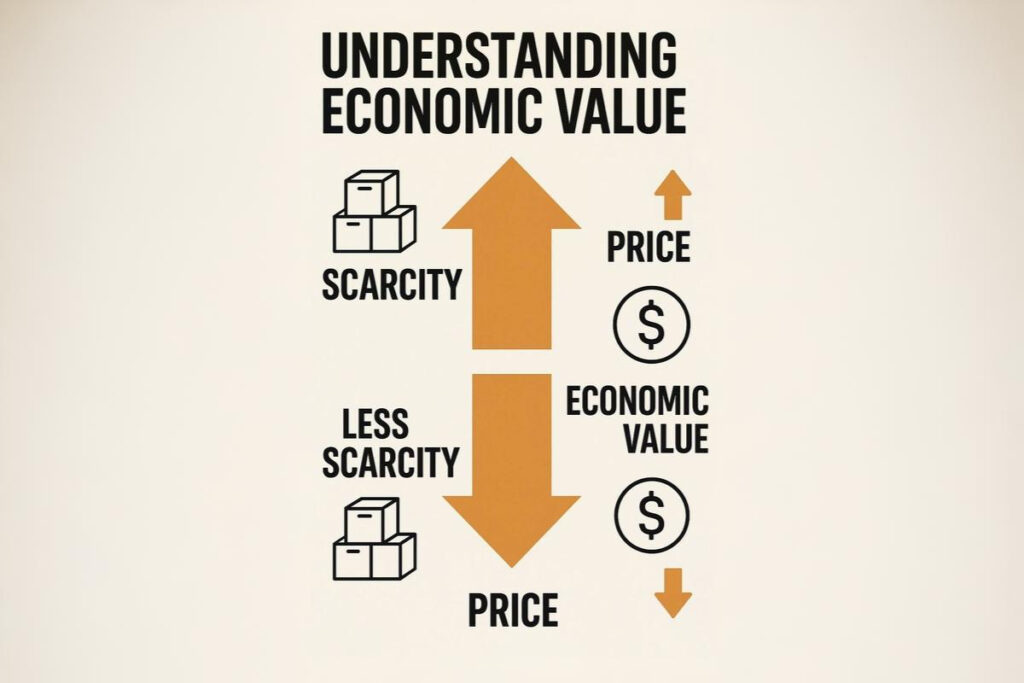
The concept of scarcity is the foundation of economic decision making, it states that we have limited resources and human wants are unlimited, we should use our resources in the most optimized way to fulfill our maximum wants from limited resources. If resources were not limited, then prices wouldn’t exist and everything would be free.
Supply, Demand, And Price Relationship
The connection between scarcity and price is linked with the concert of supply and demand, as depicted as follows:
|
Scenario |
Supply |
Demand |
Price |
|
Scarce resource, high demand |
Low |
High |
Increases |
|
Abundant resource, low demand |
High |
Low |
Decreases |
|
Balanced supply and demand |
Medium |
Medium |
Stable |
Artificial Scarcity
Yes, you read it right, scarcity is not always natural. Companies often create artificial scarcity for their products to increase their prices and make consumers perceive them as valuable items. Primary examples for it are:
Limited Edition Products → Sneakers, watches, or gaming consoles
Seasonal Pricing → Flight tickets become costlier during holidays
Luxury Branding → Designer labels charge more even if materials are similar
Real-World Examples Of Scarcity Impacting Price
In this section, we will mention some real-world examples of scarcity to help you understand the concept practically:
Gold & Diamonds – Limited availability makes them expensive.
Fuel Prices – Any disruption in oil production pushes prices up globally.
Housing Market – Property prices skyrocket in cities with limited land but high demand.
Tech Products – New iPhones or gaming consoles often have limited initial supply, making them costlier in resale markets.
Why Understanding Scarcity Helps Consumers?
Understanding the concept of scarcity helps consumers in numerous ways, such as:
Making Smart Buying Decisions
They can avoid overpaying companies for artificial scarcity created by them for their products.
Plan Investments Wisely
Understand price trends and estimate prices of commodities, stocks, and real estate to determine the best time to purchase and sell them.
Frequently Asked Questions (FAQs)
Why Does Scarcity Increase Price?
Due to scarcity, supply becomes limited, but demand remains high, which results in high prices.
Can Something Valuable Be Abundant?
Definitely, for example, air is essential for life, we can’t survive without it, and it is available in abundant quantities.
How Does Scarcity Affect Consumer Behaviour?
Scarcity makes things valuable and subconsciously influences consumers to pay more to get the item.
Conclusion
Scarcity is a core concept of economics, various theories and economic models are developed using this concept. It is important to understand its meaning and effects to make better purchase decisions and avoid being influenced by the artificial scarcity created by companies. In this article, we had a comprehensive discussion on this topic. We hope that you like reading this post and find this post informative. If so, then do share this post with others as well.








Leave a comment